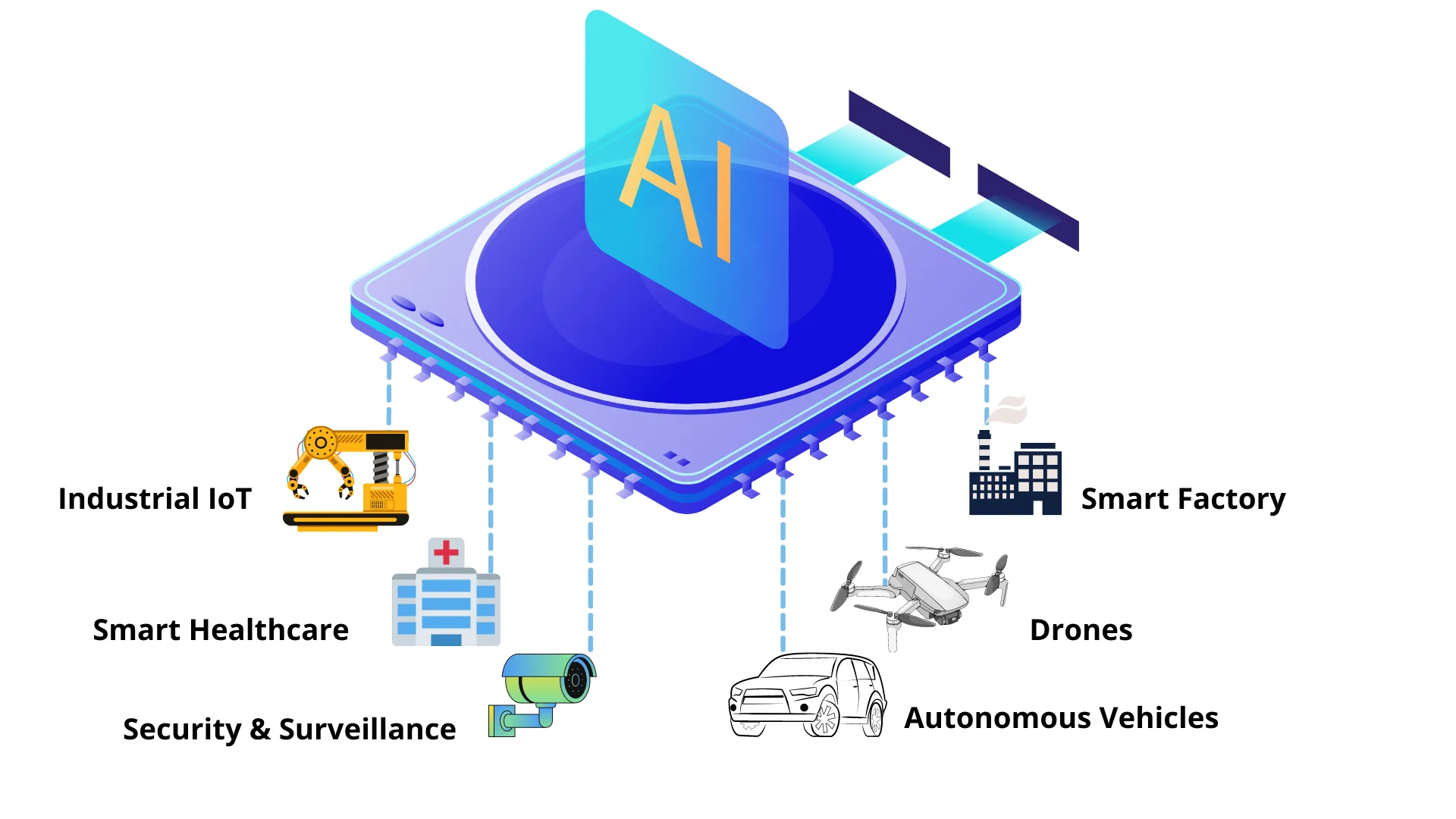
Edge AI devices are transforming the way machines think, respond, and interact with the world around us. Instead of sending data to distant cloud servers for processing, these intelligent systems analyze information right where it’s generated—on the “edge” of the network.
If you’ve ever unlocked your smartphone with facial recognition or driven a car that warns you about lane departures, you’ve already experienced the impact of this shift. What once required massive data centers can now happen inside compact, power-efficient hardware installed in homes, factories, hospitals, and vehicles.
The rise of this technology isn’t just another tech trend. It’s a foundational change in how artificial intelligence is deployed, secured, and scaled across industries.
Understanding Edge AI in Simple Terms
At its core, Edge AI combines artificial intelligence with edge computing. Traditional AI systems rely heavily on cloud infrastructure. Data travels from a device to a remote server, gets processed, and then returns with instructions.
This process works—but it introduces delays, security risks, and bandwidth costs.
Edge AI devices eliminate that round trip. They process data locally using optimized hardware such as AI accelerators, GPUs, or specialized neural processing units. This allows decisions to happen instantly.
Imagine a security camera that can detect suspicious movement and trigger alerts without ever sending footage to the cloud. That’s the practical power of Edge AI in action.
Why Edge AI Devices Matter More Than Ever
The explosion of connected sensors and smart systems has created enormous data streams. According to industry estimates, billions of IoT devices generate zettabytes of data annually. Sending all of that to the cloud simply isn’t sustainable.
Edge AI devices reduce bandwidth usage by processing only relevant insights instead of raw data. This lowers operational costs while improving speed.
In healthcare, milliseconds can determine outcomes. In autonomous driving, delays are unacceptable. In manufacturing, downtime costs thousands of dollars per minute. Real-time intelligence at the source is no longer optional—it’s essential.
The Core Technologies Powering Edge AI Devices
Modern Edge AI devices rely on advanced chip architectures and lightweight AI models. Companies like NVIDIA and Intel design specialized processors that deliver high performance with low power consumption.
Tiny machine learning frameworks allow models to run on microcontrollers. This means even compact wearables and industrial sensors can perform complex inference tasks.
Frameworks such as TensorFlow Lite and ONNX Runtime have been optimized for deployment at the edge. These tools compress models without significantly sacrificing accuracy.
This blend of hardware and software innovation is what makes scalable Edge AI possible.
Real-World Applications of Edge AI Devices
The real proof of innovation lies in practical deployment. Across sectors, Edge AI devices are already delivering measurable impact.
Smart Manufacturing
In advanced factories, predictive maintenance systems monitor equipment vibrations and temperature in real time. Instead of waiting for failures, machines alert engineers before breakdowns occur.
This reduces downtime and saves millions annually. It also improves worker safety by identifying potential hazards early.
Healthcare and Medical Diagnostics
Portable diagnostic devices now analyze patient data instantly without relying on cloud connectivity. In remote regions, this capability can mean the difference between timely treatment and dangerous delays.
AI-powered imaging tools running on local devices help clinicians detect abnormalities faster. Edge processing ensures patient data remains private and secure.
Autonomous Vehicles
Self-driving technology demands split-second decision-making. Companies like Tesla integrate onboard AI systems that process camera and sensor data locally.
Sending that data to the cloud would introduce unacceptable latency. Edge AI devices allow vehicles to react in real time to road conditions, pedestrians, and obstacles.
Smart Cities and Surveillance
Traffic management systems use localized AI to optimize signal timing and reduce congestion. Smart surveillance cameras detect unusual activity without streaming continuous footage to centralized servers.
This not only improves efficiency but also enhances data privacy compliance
Security Advantages of Edge AI Devices
One major benefit of Edge AI devices is improved cybersecurity. When sensitive data stays on the device, exposure risk decreases significantly.
Cloud breaches have become increasingly common. Processing data locally reduces attack surfaces and ensures compliance with strict data protection regulations.
For industries like finance and healthcare, this localized approach supports regulatory frameworks such as GDPR and HIPAA while maintaining operational speed.
Edge AI Devices and the IoT Revolution
The Internet of Things has connected billions of devices worldwide. However, centralizing all IoT data creates bottlenecks.
Edge AI devices act as intelligent gatekeepers. They filter, analyze, and prioritize information before transmitting only essential insights to cloud systems.
This hybrid approach—combining local intelligence with centralized analytics—maximizes efficiency and scalability.
In agriculture, for example, smart sensors analyze soil conditions and weather patterns directly in the field. Farmers receive actionable recommendations without needing constant internet connectivity.
How Businesses Are Adopting Edge AI Devices
Adoption often begins with a specific operational challenge. A logistics company might deploy smart cameras in warehouses to monitor inventory movement. A retailer may install AI-powered checkout systems to reduce wait times.
Early pilots typically demonstrate clear ROI. Reduced bandwidth costs, faster response times, and improved system resilience quickly justify expansion.
Organizations that embrace Edge AI devices strategically often combine them with cloud analytics for broader insights. This creates a distributed intelligence ecosystem.
Challenges Facing Edge AI Deployment
Despite its advantages, deploying Edge AI devices requires careful planning.
Hardware constraints limit computational resources compared to cloud servers. Developers must optimize AI models for efficiency without sacrificing accuracy.
Power consumption is another critical factor, especially in battery-operated devices.
There are also management complexities. Updating thousands of distributed devices securely demands robust device management platforms.
Companies investing in this technology must balance innovation with operational oversight.
The Future of Edge AI Devices
The trajectory of Edge AI devices points toward deeper integration into everyday life. As 5G networks expand, connectivity speeds improve, enabling even more sophisticated hybrid architectures.
Chip manufacturers are racing to design ultra-efficient AI accelerators. Meanwhile, software developers continue refining model compression techniques.
Industry analysts predict that edge deployments will outpace centralized cloud AI in many sectors over the next decade.
From wearable health monitors to industrial robotics, local intelligence will define the next wave of automation.
Why Edge AI Devices Support EEAT Principles
Expertise, Experience, Authoritativeness, and Trustworthiness are essential for evaluating modern technologies. Edge AI devices embody these principles when implemented responsibly.
Leading semiconductor firms provide transparent documentation and rigorous testing standards. Regulatory compliance frameworks ensure responsible deployment.
Case studies across manufacturing, healthcare, and transportation demonstrate measurable performance improvements.
Organizations that share validated results and security protocols build trust in their systems.
This alignment with EEAT standards strengthens credibility and fosters long-term adoption.
Edge AI Devices in Everyday Consumer Technology
Look around your home. Smart speakers, security cameras, thermostats, and even appliances are becoming more intelligent.
Voice assistants now process certain commands locally, reducing latency and improving responsiveness.
Smartphones increasingly rely on onboard AI chips for image enhancement and biometric authentication.
These everyday implementations of Edge AI devices prove that advanced computing is no longer confined to research labs or enterprise servers.
Environmental Impact and Sustainability
Edge processing can contribute to sustainability goals. By reducing data transmission to centralized data centers, overall energy consumption decreases.
Cloud infrastructure demands significant power for cooling and operation. Processing data closer to the source reduces that burden.
Manufacturers are also designing low-power AI chips to support energy-efficient deployments.
Sustainable innovation is becoming a competitive advantage in technology strategy.
Building Trust in Edge AI Deployments
Trust depends on transparency and accountability.
Companies must ensure model accuracy, eliminate bias, and provide secure update mechanisms.
Clear documentation and third-party validation strengthen reliability.
When implemented thoughtfully, Edge AI devices create systems that are not only faster but also more trustworthy.
The Competitive Edge of Early Adoption
Organizations that adopt Edge AI strategically often gain measurable advantages. Faster processing leads to better customer experiences. Reduced downtime improves operational efficiency.
Real-time analytics enable smarter decision-making at every level of the enterprise.
In rapidly evolving markets, speed and responsiveness define leadership.
Businesses that leverage Edge AI devices effectively position themselves ahead of competitors still reliant solely on centralized systems.
Integration with Emerging Technologies
Edge AI does not exist in isolation. It intersects with robotics, augmented reality, and industrial automation.
In manufacturing plants, AI-powered robots adjust operations dynamically based on sensor data processed locally.
In retail, augmented reality experiences respond instantly to user behavior.
These integrations amplify the value of Edge AI devices across sectors.
What Decision-Makers Should Consider
Before deploying Edge AI devices, leaders must assess infrastructure readiness.
They should evaluate bandwidth constraints, latency requirements, and security protocols.
Pilot programs can validate feasibility before large-scale rollouts.
Strategic alignment between IT, operations, and cybersecurity teams ensures sustainable implementation.
Final Insight on the Momentum of Edge AI Devices
The momentum behind Edge AI devices reflects a broader shift toward decentralized intelligence.
Instead of relying exclusively on distant servers, organizations and consumers alike are embracing local decision-making systems that operate in real time.
As chip innovation accelerates and AI frameworks mature, this distributed model will continue reshaping industries worldwide.
The next wave of digital transformation won’t just be connected—it will be intelligently connected at the edge.
Read also:-
how are dk380c4.0-h8
0.6 967wmiplamp
lilikateixeraa
yell51x-ouz4 for tiles