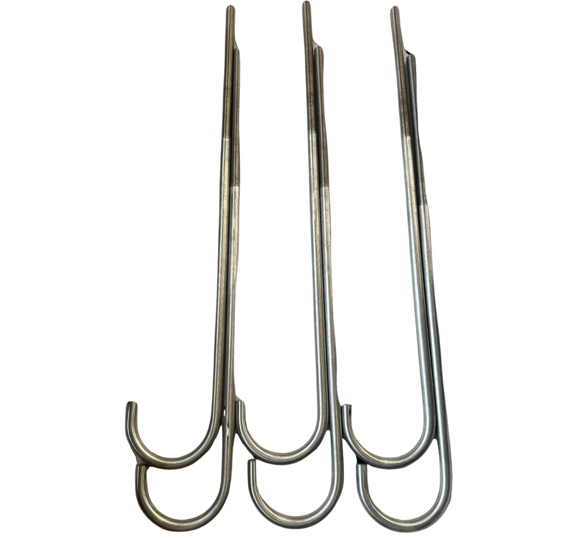
In structural and industrial construction, anchor bolts are a small component with a massive responsibility transferring loads safely from structures and machinery into concrete foundations. Companies such as E.S HAJI & CO., along with reputed Anchor Bolts manufacturers in Chennai, consistently emphasize correct spacing and placement because even high-quality bolts can fail if installed improperly.
The answer depends on several engineering factors, applicable standards, and the type of structure being supported. This article explains anchor bolt spacing in detail, covering codes, design considerations, real-world practices, and why correct spacing is critical for structural safety.
Understanding Foundation Anchor Bolts
Foundation anchor bolts are steel fasteners embedded into concrete foundations to secure structural elements such as:
- Steel columns
- Base plates
- Industrial machinery
- Towers and poles
- Pre-engineered buildings
Their primary role is to resist tensile, shear, and uplift forces, ensuring that loads are safely transferred to the concrete without movement or failure.
Spacing between anchor bolts is not arbitrary it is determined through structural design calculations and codal guidelines.
Why Anchor Bolt Spacing Is So Important
Incorrect spacing between anchor bolts can lead to serious structural problems, including:
- Uneven load distribution
- Excessive stress on individual bolts
- Concrete cracking or pull-out failure
- Misalignment of base plates
- Reduced resistance to seismic and wind loads
Even the strongest anchor bolt will underperform if spacing rules are ignored.
Installation Accuracy and Spacing Control
Even correctly designed spacing can fail if installation is inaccurate.
Best practices include:
- Use of steel templates during concreting
- Proper alignment checks before concrete pouring
- Verification after concrete curing
Reputed suppliers and installers associated with Anchor Bolts Chennai projects often emphasize precision as much as design.
Is There a Fixed Maximum Distance Between Anchor Bolts?
There is no single universal maximum distance applicable to all foundation anchor bolts. Instead, spacing is governed by:
- Structural design requirements
- Type of load (tension, shear, moment)
- Base plate dimensions
- Applicable design codes
- Concrete strength and thickness
However, industry standards and best practices provide recommended limits that engineers follow during design.
Code Guidelines Affecting Anchor Bolt Spacing in India
In India, anchor bolt spacing is influenced by multiple standards rather than one single code.
General Construction in Steel
IS 800 provides guidance on steel structure design and anchor bolt forces. While it does not specify an exact “maximum spacing,” it requires that anchor bolts:
- Adequately resist uplift and shear forces
- Be positioned to prevent excessive bending of base plates
- Maintain sufficient edge distances
Design engineers calculate bolt spacing based on load combinations defined in IS 800.
Plain and Reinforced Concrete
IS 456 indirectly influences anchor bolt spacing by defining:
- Minimum edge distances
- Concrete cover requirements
- Load transfer behavior
Anchor bolts placed too far apart may cause localized concrete stress and cracking.
Code of Practice for Foundation Bolting
IS 5624 is the most relevant standard for foundation bolts in industrial and equipment foundations.
It emphasizes:
- Proper alignment
- Correct embedment depth
- Spacing to ensure uniform load distribution
While it does not mandate one fixed maximum spacing, it recommends that spacing be designed to suit applied loads and base plate geometry.
Common Industry Practice for Maximum Anchor Bolt Spacing
Although spacing varies by application, typical maximum spacing ranges used in practice are as follows:
1. Anchor Bolts for Steel Columns
- Common spacing: 300 mm to 600 mm
- Maximum spacing (general practice): 600 mm to 900 mm
Spacing beyond this range may require thicker base plates or additional structural checks.
2. Anchor Bolts for Industrial Machinery
- Typical spacing: 250 mm to 500 mm
- Machinery foundations require closer spacing to resist vibration and dynamic loads.
Large spacing increases the risk of bolt loosening over time.
3. Anchor Bolts for Towers and Poles
- Spacing depends on base plate diameter
- Often arranged symmetrically in circular or square patterns
- Maximum spacing is governed by overturning moment calculations
4. Pre-Engineered Buildings (PEB)
- Spacing generally ranges from 400 mm to 750 mm
- Larger spans may require additional bolts rather than increased spacing
Factors That Determine Maximum Anchor Bolt Spacing
1. Load Magnitude and Type
Higher loads require either:
- More anchor bolts, or
- Reduced spacing between bolts
Uplift forces caused by wind or seismic activity are especially sensitive to spacing.
2. Base Plate Size and Thickness
Base plates distribute loads from the structure to the anchor bolts.
- Larger base plates allow wider bolt spacing
- Thin plates require closer spacing to avoid bending
3. Concrete Strength and Thickness
Stronger concrete can tolerate greater spacing, but only within limits.
Low-grade concrete requires closer bolt placement to prevent pull-out or cracking.
4. Anchor Bolt Diameter and Grade
Higher-diameter and higher-grade bolts can carry more load, sometimes allowing increased spacing but only if base plate and concrete checks are satisfied.
5. Edge Distance Requirements
Anchor bolts must maintain minimum distances from concrete edges.
Increasing spacing too much may violate edge distance rules, leading to failure.
Anchor Bolt Spacing vs. Edge Distance
Spacing and edge distance work together.
- Minimum edge distance is typically 1.5 to 2 times the bolt diameter
- Bolts placed too close to the edge risk concrete breakout
- Bolts placed too far apart increase bending stresses
Designers balance both during layout planning.
Consequences of Excessive Anchor Bolt Spacing
Spacing anchor bolts beyond recommended limits can result in:
- Base plate uplift
- Excessive bolt tension
- Uneven load sharing
- Structural vibration issues
- Premature fatigue failure
In seismic zones, improper spacing significantly increases risk.
How Engineers Decide Final Bolt Spacing
Structural engineers typically follow this process:
- Calculate loads (dead, live, wind, seismic)
- Select bolt diameter and grade
- Design base plate thickness
- Determine number of bolts required
- Finalize spacing to satisfy strength and serviceability checks
Spacing is therefore an output of design, not an assumption.
Role of Quality Anchor Bolt Manufacturers
Even the best spacing design is ineffective without quality bolts.
Reputed suppliers such as E.S HAJI & CO. and established Anchor Bolts manufacturers in Chennai ensure:
- Accurate dimensions
- Certified material grades
- Reliable threading and finishing
- Compliance with Indian Standards
This reliability allows engineers to design with confidence.
Practical Recommendations for Contractors and Site Engineers
- Never increase bolt spacing on site without design approval
- Do not substitute fewer bolts with wider spacing
- Always verify bolt layout with approved drawings
- Use proper templates to maintain spacing accuracy
Small deviations can create large structural risks.
Future Trends in Anchor Bolt Design
Modern construction is moving toward:
- Higher-strength anchor bolts
- Improved seismic design requirements
- Tighter spacing in critical structures
- Advanced analysis using finite element methods
These trends reinforce the importance of proper spacing control.
So, what is the maximum distance between foundation anchor bolts?
The correct answer is: there is no single fixed maximum. Anchor bolt spacing depends on load conditions, base plate design, concrete strength, and applicable standards. In practical construction, spacing commonly ranges from 300 mm to 900 mm, with closer spacing preferred for heavy loads and dynamic applications.